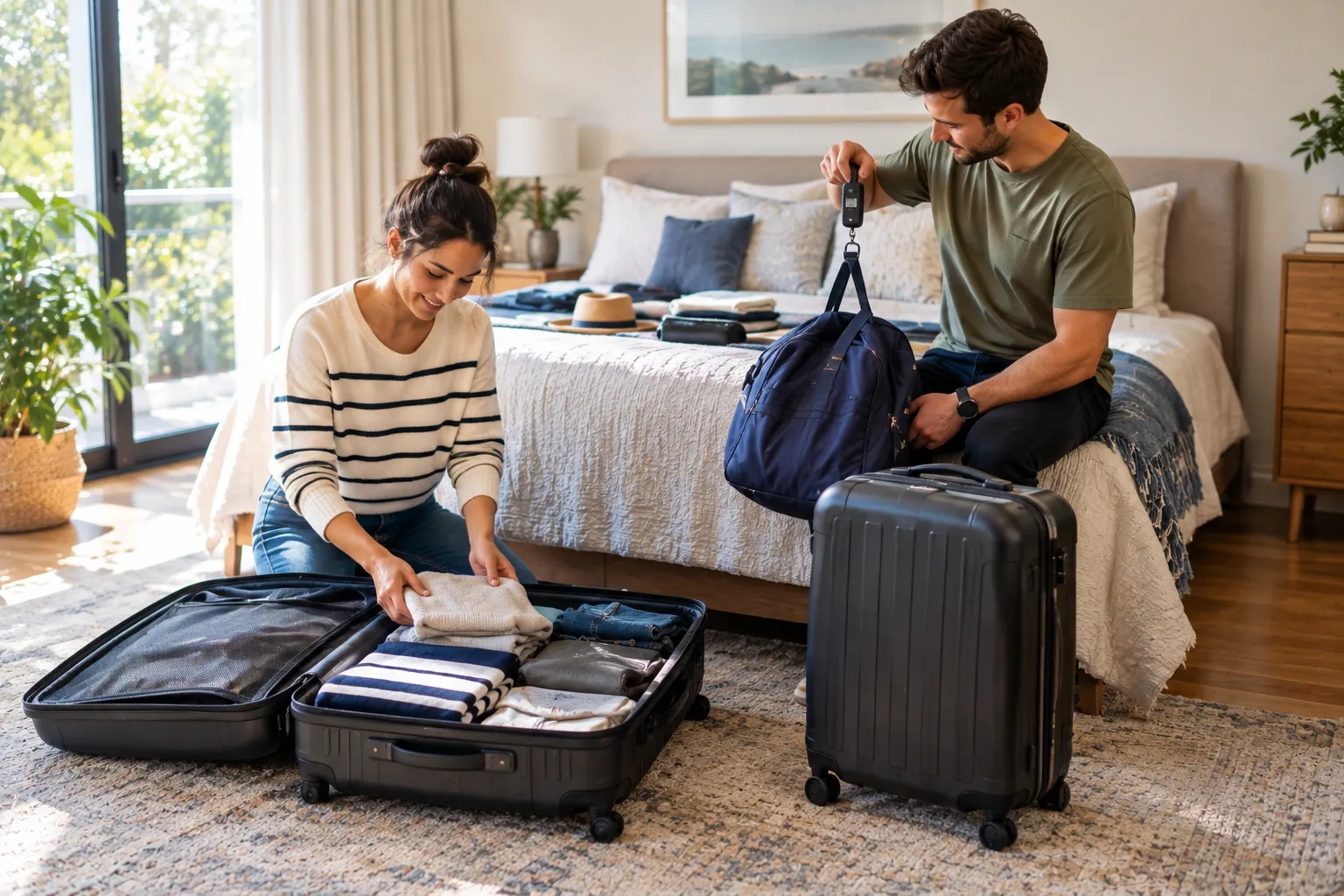
The suitcase that doesn’t fit is never the first one. It’s the fourth — already zipped, already weighed, standing on a dark kerb next to a boot that closed beautifully on three. At that point there are no good options, only bad ones: leave a bag, split the party across two cars, or watch someone try to belt a hard case into a seat.
All of it is avoidable, and the fix happens at booking, not at the kerb.
How does a transfer operator count my bags?
In three categories, and none of them is what the airline weighs. A large suitcase is anything you’d check in — the wheeled cases that go in the boot. A carry-on is what fits in an overhead locker or under a seat. An oversized item is anything that won’t lie flat in a boot: golf clubs, a boardbag, skis, a cello.
Airline allowances measure weight. Vehicle capacity measures shape. A 5 kg pillow-shaped duffel eats more boot than a heavy hard case, and the airline charges you for the opposite one. So count what physically leaves your house, in those three buckets, before you touch the booking form.
Two things travellers routinely forget to count: the duty-free bag on the way home, and the backpack you’re wearing. Both are real objects that need real space.
Why can’t I have every seat and every bag?
Because in most vehicles the luggage space and the back row of seats are the same cubic metres, used one way or the other. A people mover’s rearmost row folds down into the boot floor. Put people in it and the boot shrinks to a shelf; fold it away for bags and you’ve lost the seats.
This is the most common capacity surprise, and it’s why a vehicle described as seating seven is not a seven-passengers-plus-seven-suitcases vehicle. Every operator faces the same physics. The difference is whether they tell you before you pay or after you arrive.
Our vehicle pages publish seats, large bags and carry-ons as separate numbers rather than one flattering headline, and the booking flow checks all three against what you declare. Where a vehicle can trade seats for bag space, it does so explicitly and the seat count drops in front of you.
Child restraints tighten it again. A fitted seat occupies a full passenger seat, and our recommender is deliberately more conservative still: it reserves an extra seat’s worth of room per restraint, because a rear-facing capsule intrudes on the space beside it and a booster needs elbow room to buckle. The NSW child seat rules cover which restraint each age needs.
What counts as an oversized item?
Anything long, rigid or awkwardly shaped that can’t be stacked: golf bags, surfboards and boardbags, skis and snowboards, boxed bicycles, cellos, double basses, guitar flight cases, camera and lighting cases, fishing rod tubes, and folded mobility scooters.
In our booking flow, each oversized item consumes two large-bag slots, because that’s honestly what it does to a boot. Two sets of golf clubs is not “two extra bags” — it’s four bags’ worth of space, plus the party’s actual suitcases. Groups travelling with sports gear almost always need a bigger vehicle than the passenger count alone suggests, and it’s better to learn that on a Tuesday than at 4am.
A few specifics belong in the notes field rather than the counter:
- Surfboards. Length matters more than quantity. A single longboard can be harder to place than three shortboards.
- Instruments. Say if it can’t lie flat or travel in the boot at all. Some instruments need a seat, and a seat has to be booked.
- Boxed bikes. Give the rough box size. Bike boxes vary enormously.
- Prams. Declare it as a pram, not a bag. A compact travel stroller and a tandem pram are different problems, and the toggle exists so the driver arrives expecting one.
Can you carry a wheelchair or mobility aid?
A folding manual wheelchair that collapses into the boot travels as an oversized item — declare it and we’ll size the vehicle for it. A powered chair, or a chair that must stay assembled and occupied, is different: our current fleet has no wheelchair-accessible vehicle, and the quote form says so on the screen rather than accepting the request and sorting it out later.
That’s a real limitation, stated plainly. If a chair must stay assembled, book a wheelchair-accessible service. If you’re travelling with an older passenger who walks but needs help with bags and distance, elderly assistance is the right box to tick — that’s door-to-door help, not a vehicle change.
What should I declare when I book, and why?
All of it: adults, children, infants, each child’s age, large suitcases, carry-ons, oversized items, prams, and any mobility aid. Every one of those fields drives something concrete — the vehicle recommended, the legality of the trip under NSW restraint law, and the fixed fare you’re quoted.
The reason to be honest isn’t politeness. The declaration is what the quote is calculated from. Undercount your bags and the system will cheerfully recommend a vehicle that cannot carry them, and you’ll have paid for a car that was never going to work. Overcount slightly and the worst outcome is a marginally larger vehicle and some spare room — which, at 4am with a family, is not a bad outcome.
Infants count as passengers even when you expect to hold them. The NSW rules require an approved restraint for an infant, and a fitted restraint occupies a seat, so the recommender counts them accordingly.
What happens if I turn up with more than I booked for?
The driver tells you, on the kerb, that it doesn’t fit. Under our terms, if passengers, luggage or child ages materially differ from the booking at pickup, the trip may be declined or adjusted, and any fare difference or applicable fee is advised before anything proceeds. Nothing is charged silently.
Adjusted usually means a second vehicle, if one is available at that hour — and at 4am in school holidays, availability is not a given. Declined means you’re standing on the kerb solving a transport problem with a boarding time. Neither is a punishment; both are what happens when a car arrives sized for a booking that no longer describes the trip.
This is also one of the easiest problems to avoid entirely. Tell us the moment the bag count changes — reply to our call, or email us through the contact page. The night before is fine. The morning of is fine. Standing on the kerb is not.
Packing for a 4am pickup
Do the physical work the night before. Bags by the door, zipped and stacked in the order they load. Nothing still open “for the toothbrush” — that last-minute repack is where an extra tote appears, and an extra tote at 4am is a real object the boot has to swallow.
Then:
- Consolidate at home, not on the kerb. Redistributing between cases in a dark driveway costs pickup time that belongs to your flight.
- Passports, wallet, phone, medication and keys in one small bag that never enters the boot. It rides with you.
- Photograph the pile before you book. Count it on the screen, not from memory.
- Plan the return leg. People fly out with three bags and home with five. Book the return for what you’ll be carrying then.
- Charge everything overnight. A dead phone at a pre-dawn pickup means no driver messages and no boarding pass.
Pre-dawn starts are becoming more common. Western Sydney International, whose first passenger day is 25 October 2026, is curfew-free, so Sydney gains departures at hours Kingsford Smith’s 11pm–6am curfew does not allow. There’s no train to WSI until the Sydney Metro line opens, and while the free WSI Link shuttle from St Marys station starts its day at 4.30am, moving a family and five suitcases from a train to a shuttle before dawn is a specific kind of ordeal. That’s the trip a booked vehicle solves, provided the vehicle was booked for the right amount of luggage.
The short version
Count large suitcases, carry-ons and oversized items separately, and count them from the actual pile. Remember that seats and boot space compete for the same volume, and that restraints and oversized gear consume more capacity than the headcount suggests. Declare everything when you request your quote, tell us the moment it changes, and the only thing left to worry about at 4am is whether you turned the heater off.
Get a quote and the vehicle recommendation is calculated from what you declare — no guessing at the kerb.